
Is it legal?
Emerald tree boas are not restricted by California or Florida as we last checked. Colorado's new rules allow giant snakes in the family Boidae only if they are native only to the tropics and subtropics, which should cover emerald tree boas, so confirm with CPW. Local laws vary.
Not legal advice. Use the full checker for more species and states.
Enclosure
Emerald tree boas live in the trees. Height and perches matter far more than floor space.
| Hatchling | Small tall tub or 12×12×18 in enclosure |
|---|---|
| Juvenile | 18×18×24 in |
| Adult | 24×18×36 in is a common minimum. 3×2×4 ft or taller is better |
- Tall, front-opening: A door on the front causes less stress than a lid that opens from above.
- Ventilation: Use plenty of screen or vents. Stale damp air is the biggest risk.
- Secure lid: They are good at slipping through small gaps.
- One snake per enclosure.
Temperature
| Basking perch | 86–88°F |
|---|---|
| Daytime air | 78–84°F |
| Night | 72–76°F |
| Danger zone | Above 90°F anywhere in the enclosure |
- Heat source: A halogen flood or a ceramic heat emitter above one perch, on a thermostat.
- Thermostat: Always. These snakes overheat easily.
- Measure it: Use an infrared temperature gun and digital probes at the perch.
Humidity
Keep humidity around 60–70%, higher right after misting and drying slightly between mistings.
- Mist the enclosure once or twice a day. Emerald tree boas drink droplets from the leaves.
- Use a digital hygrometer.
- Stagnant, soaked conditions cause respiratory infections.
Hides and decor
- Horizontal perches: Provide at least two at different heights, about as thick as the snake's body. The snake will sit on one for days.
- Foliage: Live or fake plants give cover and hold water droplets.
- Avoid sharp edges: Check all furniture for splinters.
Substrate
| Good choices | Cypress mulch, coconut husk or sphagnum moss, 2 inches deep |
|---|---|
| Okay | Paper towels for new or sick animals |
| Avoid | Cedar and pine, sand, corn cob |
- Spot-clean droppings right away and replace all bedding every 1–2 months.
Water
Water droplets from misting are the main source, but offer a water bowl too. Change it often.
Feeding
Emerald tree boas are ambush feeders and gain weight easily. Do not overfeed.
| Hatchling | Pinky or fuzzy mice, every 7–10 days |
|---|---|
| Juvenile | Hopper mice, every 10–14 days |
| Adult | Small mice or a small rat, every 2–3 weeks |
- Size: The prey should be no thicker than the widest part of the snake.
- Frozen-thawed: Safer than live. Use long tongs, and keep your hands away.
- Feeding response: They strike fast. Hold prey at a distance, and do not hand-feed.
- Obesity: Keep the snake lean.
Handling and behavior
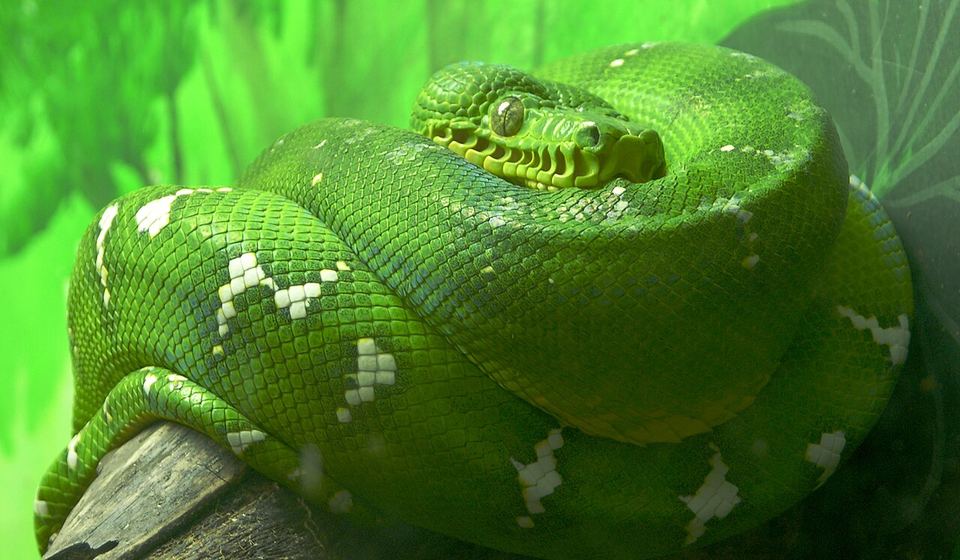
Emerald tree boas are fast, defensive and have some of the longest teeth of any harmless snake. A bite can bleed heavily and cause infection. They are not a snake for children, for beginners or for hands-on handling.
- Emerald tree boas are defensive and nervous. Even long-term captives stay bitey.
- Their front teeth are very long, and the bite bleeds heavily and can cause deep wounds.
- Handle as little as possible, and never without a plan. Use a snake hook to move them, and treat each handling as a calculated risk.
- Never handle after feeding or when the snake smells like food.
- Wash your hands before and after handling.
Common health problems
- Respiratory infection and mouth rot: wheezing, bubbles, cheesy white material in the mouth. Often from cold or stagnant, damp conditions.
- Regurgitation: from low temperatures, handling after a meal or overfeeding.
- Parasites: wild-caught imports often carry them. Have a vet test a fecal sample.
- Obesity: from overfeeding.
- Mites: small dark specks on the snake or in the water bowl.
- Stuck shed: from low humidity.
Find an exotic-animal vet before you need one.
Common mistakes
- Buying a wild-caught import. Always choose a captive-bred snake from a breeder.
- A hot, stuffy or soaked enclosure.
- No thermostat.
- Too few perches.
- Overfeeding.
- Handling too much.
- Hand-feeding.
Gear and cost
Expect to spend roughly $400–900 on a full adult setup. A captive-bred emerald tree boa costs about $300–1,000, and more for rare localities.
- Tall front-opening enclosure (24×18×36 in or larger)
- Halogen or ceramic heater on a thermostat
- Digital thermometer, infrared temperature gun and hygrometer
- Horizontal perches, foliage and a hide
- Misting bottle or system, bedding and frozen-thawed rodents
See the full emerald tree boa setup guide →
Shopping links are on the setup guide. Some may become affiliate links, which would earn Lantern Reptiles a commission at no extra cost to you.
Quick answers about the emerald tree boa
How big does a emerald tree boa get?
An adult emerald tree boa is typically 5–6.5 ft long and weighs 2–4 lb. Individuals vary.
How long does a emerald tree boa live?
Emerald tree boas usually live 15–20 years with good care, so it is a long commitment.
Is a emerald tree boa good for beginners?
We rate the emerald tree boa as: expert. It is better suited to a keeper with some experience. Read the full guide before you decide.
Does a emerald tree boa need UVB lighting?
UVB: not required. Most keepers do not use it for this animal, but check the full guide for the lighting we recommend.
What does a emerald tree boa eat?
Mice, then small rats. See the feeding section of this guide for how often and how much.
What size enclosure does an adult emerald tree boa need?
24×18×36 in is a common minimum. 3×2×4 ft or taller is better.
What temperature does a emerald tree boa need?
Basking perch: 86–88°F. Use a thermostat and a digital thermometer, and give the animal a cooler area to move to.
Is it legal to own a emerald tree boa?
It depends on your state. Use our legal checker or the state-by-state laws. Cities, counties and landlords can add their own rules.
Care figures reflect common keeper practice and vary by animal and home. Reviewed by the Lantern Keeper. Not veterinary or legal advice.