
Is it legal?
Several states restrict or ban water monitors, including New York and Iowa, and many require permits. California and Florida do not specifically prohibit them as we last checked. Colorado's rules depend on native range, so confirm with CPW. Local laws vary.
Not legal advice. Use the full checker for more species and states.
Enclosure
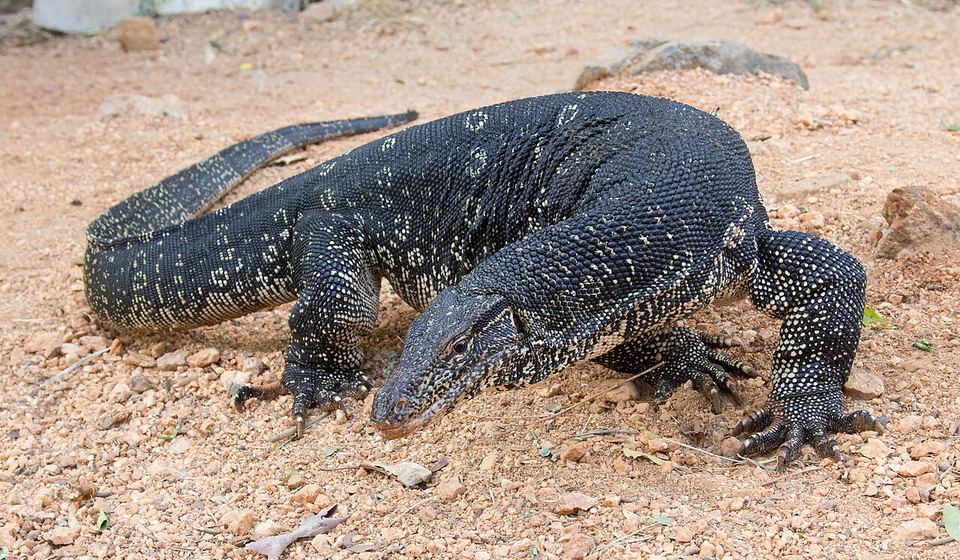
Asian water monitors are large and semi-aquatic. A full-grown one needs a room-sized, waterproof enclosure with a big pool.
| Hatchling | 4×2×2 ft with a water area |
|---|---|
| Juvenile | 6×3×3 ft |
| Adult | 12×6×6 ft is a common minimum. Many keepers use a dedicated room or outdoor-style building |
- Material: Use heavy-duty PVC, sealed wood or a custom room. Standard tanks will not hold one.
- Security: Use real locks. Water monitors are strong and smart.
- Plan ahead: A hatchling grows fast. Do not buy one without a place for the adult.
Temperature
| Basking surface | 130–150°F |
|---|---|
| Warm side (air) | 88–95°F |
| Cool side | 78–85°F |
| Water | 78–84°F |
| Night | 75–80°F |
- Basking: Use a powerful basking light over a flat rock, with a thermostat.
- Measure: Use an infrared temperature gun and digital probes.
- Safety: Guard heat lamps so a large monitor cannot knock them down.
Lighting
Asian water monitors need strong UVB to prevent bone disease.
- Use a linear T5 HO UVB tube at the recommended distance over the basking area.
- Replace it every 6–12 months, even if it still glows.
- Use a timer for 12 hours of light a day.
Humidity
Keep humidity around 60–80%. A large pool and damp substrate do most of the work.
- A digital hygrometer shows how it is going.
- Ventilation keeps the air from staying stale.
Hides and decor
- Large hides or burrows on the warm and cool sides.
- A large pool: Water monitors swim and soak every day.
- Strong basking platforms that hold their weight and are easy to climb onto.
Substrate
| Good choices | A deep (12 inch or more) layer of topsoil, cypress mulch and sand, kept damp |
|---|---|
| Avoid | Cedar and pine, shallow substrate |
- Spot-clean droppings. Replace the top layer regularly, since damp substrate gets dirty quickly.
Water
Provide a pool large enough to submerge in. Water monitors defecate in water, so use strong filtration or change it daily.
Feeding
Asian water monitors eat whole prey and fish. Adults need a lot of food.
| Hatchling | Insects and small prey every day |
|---|---|
| Juvenile | Insects, fish and rodents every other day |
| Adult | Whole prey such as rats, chicks and fish, 2–4 times a week |
- Whole prey: Frozen-thawed rodents, chicks and fish, in varied sizes.
- Insects: Gut-loaded and dusted with calcium for juveniles.
- Avoid overfeeding: Obesity is common.
Handling and behavior
A large Asian water monitor can seriously injure a keeper. Many are surrendered to rescues when they outgrow their owners. Never release a pet reptile.
- Water monitors can become tame with years of daily handling, but adults are very strong and can be aggressive.
- Adults can bite deeply, scratch and whip their tails. Never handle a large one alone.
- Wash your hands before and after handling. Reptiles can carry Salmonella.
Common health problems
- Metabolic bone disease: from low UVB or calcium.
- Obesity: a common problem.
- Respiratory infection: from cold or damp conditions.
- Skin infections: from dirty water.
- Parasites: have a vet test a fecal sample, especially for imports.
Find an exotic-animal vet before you need one.
Common mistakes
- Buying a cheap hatchling without a plan for the adult.
- An enclosure that is not strong enough.
- Dirty water.
- A basking spot that is too cool.
- Handling large adults alone.
- Ignoring the law.
Gear and cost
Expect to spend roughly $3,000–8,000 or more on an adult setup. A hatchling often costs under $200, but the enclosure is the real cost.
- Large custom enclosure or dedicated room
- T5 HO UVB tubes, basking lamps and thermostats
- Infrared temperature gun and digital probes
- Large pool with strong filtration, hides and sturdy rocks
- Calcium, whole prey and fish
See the full asian water monitor setup guide →
Shopping links are on the setup guide. Some may become affiliate links, which would earn Lantern Reptiles a commission at no extra cost to you.
Quick answers about the asian water monitor
How big does a asian water monitor get?
An adult asian water monitor is typically 5–8 ft long and weighs 20–50 lb. Individuals vary.
How long does a asian water monitor live?
Asian water monitors usually live 15–25 years with good care, so it is a long commitment.
Is a asian water monitor good for beginners?
We rate the asian water monitor as: expert. It is better suited to a keeper with some experience. Read the full guide before you decide.
Does a asian water monitor need UVB lighting?
UVB: required. Use a proper reptile UVB tube, replaced on the maker schedule.
What does a asian water monitor eat?
Whole prey and fish. See the feeding section of this guide for how often and how much.
What size enclosure does an adult asian water monitor need?
12×6×6 ft is a common minimum. Many keepers use a dedicated room or outdoor-style building.
What temperature does a asian water monitor need?
Basking surface: 130–150°F. Use a thermostat and a digital thermometer, and give the animal a cooler area to move to.
Is it legal to own a asian water monitor?
It depends on your state. Use our legal checker or the state-by-state laws. Cities, counties and landlords can add their own rules.
Care figures reflect common keeper practice and vary by animal and home. Reviewed by the Lantern Keeper. Not veterinary or legal advice.