
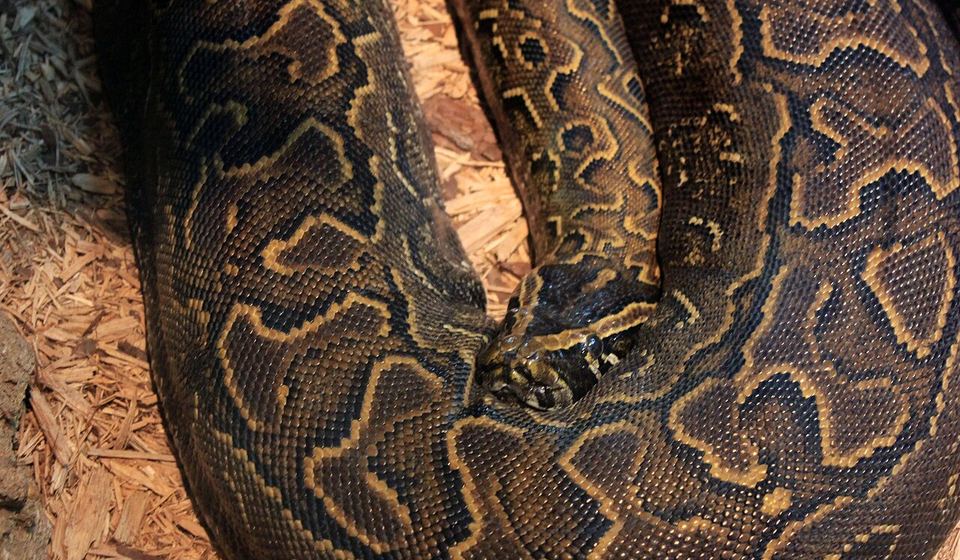
Is it legal?
Federal law (the Lacey Act) lists African rock pythons as injurious species, which bars importing them. Florida prohibits new private ownership, and several other states restrict or ban them. California does not restrict them at the state level as we last checked. Colorado's rules depend on native range, so confirm with CPW. Local laws vary.
Not legal advice. Use the full checker for more species and states.
Enclosure
African rock pythons need a very large, strong enclosure. A full-grown adult needs a custom, room-sized setup.
| Hatchling | 20–40 gallon tank or large tub |
|---|---|
| Juvenile | 4×2×2 ft |
| Sub-adult | 6×3×2 ft |
| Adult | 8×4×4 ft at minimum. Large adults need more |
- Material: Use heavy-duty PVC, sealed wood or a custom enclosure.
- Security: Use real locks. Never rely on latches or gravity.
- Plan ahead: A hatchling grows fast. Do not buy one without a place for the adult.
Temperature
| Warm side (surface) | 88–92°F |
|---|---|
| Cool side | 78–82°F |
| Night | Do not let it fall below about 75°F |
- Use a radiant heat panel or ceramic emitter on a thermostat, sized for a large enclosure.
- Measure with an infrared temperature gun and digital probes.
Humidity
Keep humidity around 60–70%. A large water bowl, damp substrate and a humid hide do most of the work.
- Use a digital hygrometer.
- Keep air moving. Stale damp air causes respiratory infections.
Hides and decor
- Large hides: The snake should fit inside. Make them sturdy.
- Furniture: Everything must hold the snake's weight.
- Water: A large soaking tub. They like to soak.
Substrate
| Good choices | Cypress mulch or coconut husk, 2–3 inches deep |
|---|---|
| Avoid | Cedar and pine, sand, corn cob |
- Spot-clean waste right away and replace all bedding every 1–3 months.
Feeding
| Hatchling | Rat pups to small rats, every 5–7 days |
|---|---|
| Juvenile | Rats, every 7–10 days |
| Adult | Large rats to rabbits, every 2–4 weeks |
- Size: The prey should be about as thick as the widest part of the snake.
- Frozen-thawed: Safer than live prey.
- Feeding response: They can be explosive feeders. Use long tongs and keep your hands away from the head.
Handling and behavior
African rock pythons are among the most dangerous pythons kept in captivity. They have caused fatal attacks on keepers and are not a pet for beginners or for homes with children.
- African rock pythons are defensive and strike fast. Many keepers handle adults as little as possible.
- Never handle alone once the snake is over about 6 feet.
- Never handle with your face near the snake.
- Do not handle when the snake smells like food. Skip handling during shed and after meals.
Common health problems
- Respiratory infection from cold or damp conditions.
- Mites and stuck shed.
- Scale rot from wet, dirty bedding.
- Parasites: wild-caught imports carry them. Have a vet test a fecal sample.
- Inclusion body disease (IBD): quarantine new snakes for at least 90 days.
Find an exotic-animal vet before you need one.
Common mistakes
- Buying one without checking federal and state law.
- An enclosure that is not strong enough.
- Handling alone.
- Underestimating size and temper.
- No thermostat.
- Releasing an unwanted one. Never release a pet reptile.
Gear and cost
Expect to spend roughly $1,500–4,000 or more on an adult setup. The legal limits make buying difficult, and prices for animals vary widely.
- Heavy-duty custom or PVC enclosure with locks
- Heat panel or emitter and a thermostat
- Digital thermometers, infrared temperature gun and hygrometer
- Large hides, soaking tub and tongs
- Bedding and frozen-thawed prey
See the full african rock python setup guide →
Shopping links are on the setup guide. Some may become affiliate links, which would earn Lantern Reptiles a commission at no extra cost to you.
Quick answers about the african rock python
How big does a african rock python get?
An adult african rock python is typically 10–16 ft (up to 20 ft) long and weighs 75–200 lb. Individuals vary.
How long does a african rock python live?
African rock pythons usually live 20–30 years with good care, so it is a long commitment.
Is a african rock python good for beginners?
We rate the african rock python as: expert. It is better suited to a keeper with some experience. Read the full guide before you decide.
Does a african rock python need UVB lighting?
UVB: not required. Most keepers do not use it for this animal, but check the full guide for the lighting we recommend.
What does a african rock python eat?
Rodents, then rabbits and larger prey. See the feeding section of this guide for how often and how much.
What size enclosure does an adult african rock python need?
8×4×4 ft at minimum. Large adults need more.
What temperature does a african rock python need?
Warm side (surface): 88–92°F. Use a thermostat and a digital thermometer, and give the animal a cooler area to move to.
Is it legal to own a african rock python?
It depends on your state. Use our legal checker or the state-by-state laws. Cities, counties and landlords can add their own rules.
Care figures reflect common keeper practice and vary by animal and home. Reviewed by the Lantern Keeper. Not veterinary or legal advice.