
Is it legal?
Bearded dragons are not restricted by California or Florida. Colorado's new rules appear to leave them off the allowed list, so check the Colorado result carefully and confirm with CPW before buying.
Not legal advice. Use the full checker for more species and states.
Enclosure
Bearded dragons are active and need floor space. Start with the adult size if you can, since babies in huge tanks can still do well with enough hides and cover.
| Baby (under 8 in) | 20–40 gallon |
|---|---|
| Juvenile | 40–75 gallon |
| Adult | 4×2×2 ft (about 120 gallons) is the usual minimum |
- Material: PVC or glass front-opening enclosures are easiest to heat and light. Screen tops let out too much heat, so use a mostly solid top with openings for the lights.
- Placement: Keep it away from drafts and direct sun.
- Security: Use a secure lid or top if you have pets or kids.
Temperature
| Basking surface | 100–110°F (babies closer to 105–110°F, adults 100–105°F) |
|---|---|
| Warm side (ambient) | 85–90°F |
| Cool side | 75–85°F |
| Night | 65–75°F. No extra heat needed unless the room drops below 65°F |
- Basking light: Use a halogen flood or similar bulb aimed at a flat rock or log, on a dimmer or thermostat.
- Measure it: Use an infrared temperature gun on the basking surface, plus digital probes for ambient air. Stick-on dial thermometers are often wrong.
- Thermostat: Use one on every heat source.
- Skip: Hot rocks, and heat lamps with no way to control them.
UVB lighting
Bearded dragons need UVB light to make vitamin D and absorb calcium. Without it they develop metabolic bone disease, which is painful and often fatal.
- Use a linear T5 HO UVB tube, usually rated 10–12% UVB, that spans most of the enclosure. Coil bulbs are less reliable.
- Mount it at the distance the manufacturer recommends. Check how far away it should be from where the dragon basks.
- Replace the tube every 6–12 months, even if it still glows. UVB output fades before the light does.
- Run lights on a timer, about 12 hours on and 12 hours off. Dim or turn off heat lamps at night.
- Provide shade as well, so the dragon can leave the light.
Humidity
Bearded dragons come from dry country. Keep humidity around 30–40%. High humidity leads to respiratory infections and skin problems.
- A digital hygrometer is useful.
- A shallow water dish and weekly baths are enough. Mist greens, not the whole enclosure.
Hides and decor
- One hide on the cool side so the dragon can get away from the light.
- A basking platform: a flat rock, slate or sturdy log under the basking light.
- Climbing: branches or a ramp at a gentle angle.
- Clutter: a few safe decorations. Keep everything stable so nothing falls on the dragon.
Substrate
| Safest | Reptile tile, non-adhesive shelf liner, paper towels |
|---|---|
| Okay for adults | Washable reptile carpet, with care to remove fraying fibers |
| Be careful | Loose sand or fine particles, especially for babies. These can cause impaction if swallowed. Many keepers avoid them completely |
Spot-clean droppings daily and wipe the enclosure down weekly.
Feeding and water
| Baby | Insects 2–3 times a day, plus fresh greens offered daily |
|---|---|
| Juvenile | Insects once or twice a day, plus fresh greens daily |
| Adult | Fresh greens daily (about 70–80% of the diet), insects every other day or a few times a week |
- Insects: Dubia roaches, crickets, black soldier fly larvae and hornworms. Feed insects no bigger than the space between the dragon's eyes. Keep insects well fed ("gut-loaded").
- Greens: Collard, mustard and turnip greens, dandelion greens, and squash. Chop finely for babies.
- Supplements: Dust insects with calcium at most feedings, and a multivitamin once or twice a week, following the product label. Ask a reptile vet about vitamin D3 if your UVB is weak.
- Avoid: Spinach and iceberg lettuce in quantity, avocado, and wild-caught insects. Fireflies are toxic and should never be fed.
- Water: Offer a shallow dish and mist greens. Bathe the dragon in a few inches of lukewarm water about once a week.
Handling and behavior
- Bearded dragons usually tolerate and enjoy handling. Short daily sessions help them get used to it.
- Support the body and legs, and wash your hands before and after.
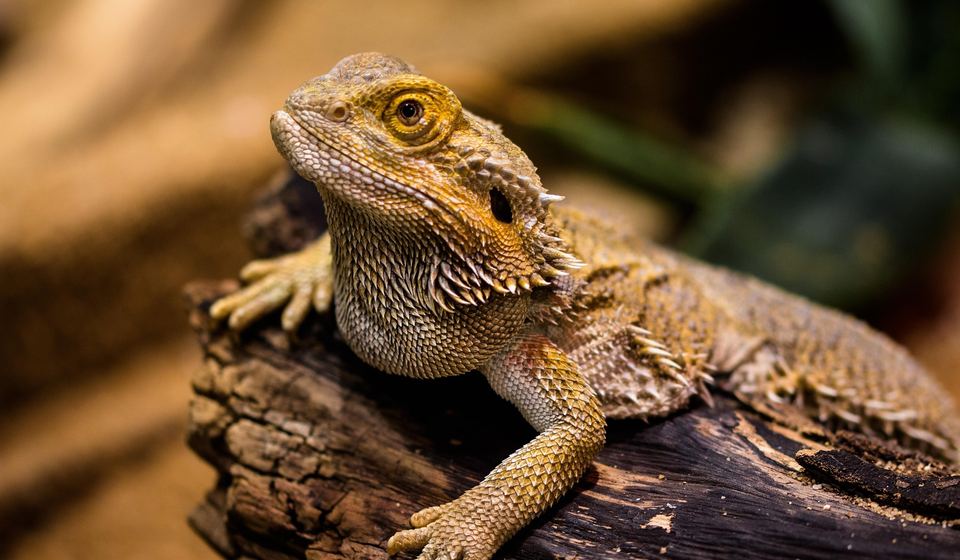
- Arm waving is a submissive gesture. Head bobbing is often dominance or courtship. Beard puffing and darkening mean stress or anger.
- Brumation: In fall or winter, an adult may sleep more and eat less for weeks. Check with a reptile vet the first time to rule out illness.
Common health problems
- Metabolic bone disease: weak limbs, tremors, soft jaw. Caused by poor UVB or calcium.
- Impaction: a blocked gut, often from loose substrate or food that is too large.
- Mites: tiny red or black specks on the skin.
- Yellow fungus and mouth rot: yellow or brown patches, or swelling around the mouth.
- Parasites: common in young animals. A fecal test at the vet is worth doing.
- Atadenovirus: a common virus in young dragons that causes poor growth and wasting.
Find an exotic-animal vet before you need one. Bearded dragons hide illness.
Common mistakes
- Weak or missing UVB, or a UVB tube that has never been replaced.
- A basking spot that is too cool.
- Loose sand for babies.
- Feeding too many insects and too few greens to adults.
- Insects that are too large.
- High humidity.
- Keeping two dragons together. They can fight and one may stress or injure the other.
Gear and cost
Expect to spend roughly $400–800 on a full adult setup. The dragon itself costs about $50–200 depending on the morph.
- Adult-size enclosure
- T5 HO UVB tube and fixture, plus a basking bulb
- Thermostat or dimmer, and a timer
- Infrared temperature gun and digital hygrometer
- Basking platform, hide, water dish
- Calcium and multivitamin powder, plus insects and greens
See the full bearded dragon setup guide →
Shopping links are on the setup guide. Some may become affiliate links, which would earn Lantern Reptiles a commission at no extra cost to you.
Quick answers about the bearded dragon
How big does a bearded dragon get?
An adult bearded dragon is typically 16–24 in long and weighs 10–18 oz. Individuals vary.
How long does a bearded dragon live?
Bearded dragons usually live 8–12 years with good care, so it is a long commitment.
Is a bearded dragon good for beginners?
We rate the bearded dragon as: beginner-friendly. It is a common first choice, but read the full guide first.
Does a bearded dragon need UVB lighting?
UVB: required. Use a proper reptile UVB tube, replaced on the maker schedule.
What does a bearded dragon eat?
Insects and greens. See the feeding section of this guide for how often and how much.
What size enclosure does an adult bearded dragon need?
4×2×2 ft (about 120 gallons) is the usual minimum.
What temperature does a bearded dragon need?
Basking surface: 100–110°F (babies closer to 105–110°F, adults 100–105°F). Use a thermostat and a digital thermometer, and give the animal a cooler area to move to.
Is it legal to own a bearded dragon?
It depends on your state. Use our legal checker or the state-by-state laws. Cities, counties and landlords can add their own rules.
Care figures reflect common keeper practice and vary by animal and home. Reviewed by the Lantern Keeper. Not veterinary or legal advice.